Thursday, 5 November 2009

The Ice was all around


And through the drifts the snowy clifts
Did send a dismal sheen:
Nor shapes of men or beasts we ken –
The ice was all between,

The ice was here, the ice was there,
The ice was all around:
It cracked and growled, and roared and howled,
Like noises in a swound!

From The Rime of the Ancient Mariner, by Samuel Taylor Coleridge.


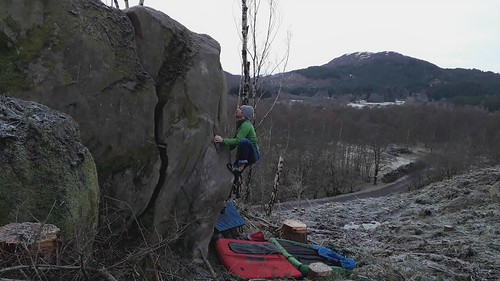
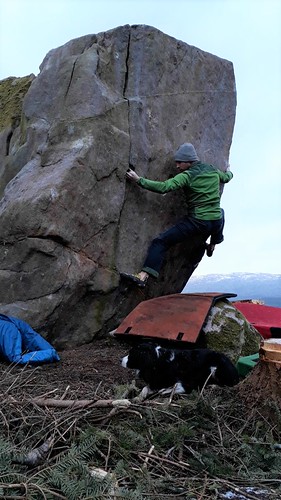
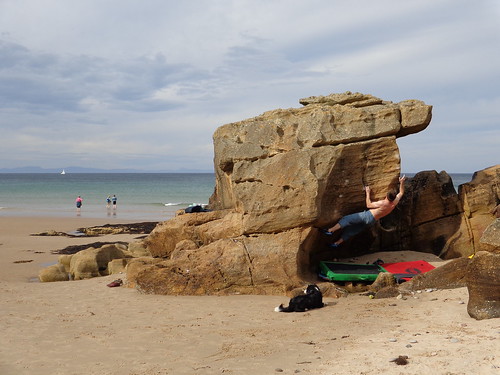
The view to come. Photo: Viv Scott
With the changing of the clocks something stirs in the Highlands. There’s a discernable feeling of the new season approaching; a switching of the gears in readiness for the long dark months ahead. Headlights illumine the daily commute. A torch comes to hand when walking the dog. Jackets and hats and gloves start to make their way onto the hooks in the hallway. The coal bucket fills and empties, the embers glow in the stove.

Then the murmuring begins. Starting low but slowly, slowly gathering and lifting, building to a clamoring gaggle: the expectant buzz. Training and boulders, hilltops and hot-aches, tall tales from times past, big ideas about times to come. Plans.

Where will you be this winter?

Wednesday, 28 October 2009

Downtime

It’s funny how things go. You anticipate and expect so much. You plan, you stress, you strain, you sweat and you train, and then, just like that, it’s over. Like a climbing project, you always inflate it in your head until it feels like a massive challenge, but when you actually do it, it doesn’t feel like such a big deal.

I’d be lying if I said I hadn’t been worried about competing in the OMM this year, but it seems like a healthy dose of fear was needed to kick my arse into gear. Somehow, and I’m still not really sure how, Duncan and I came 9th overall in the Elite Class. Given that we were initially thinking that simply completing the race would be worthy of celebration we’re pretty pleased.

So, what was it like? Well, let’s put it this way, I won’t be volunteering as an ambassador for the Elan Valley tourist board. The place is one big bog, covered in a thin veneer of bog, surrounded by a load of bog with bog in the bits between the bogs. Shoe-sucking, knee-deep, peat-black bog. Okay, I’m probably overdoing it. In fact, it’s not all bog, because there are the hundreds of square miles of tussocky grass, waiting for an unsuspecting ankle to snap or groin to strain too. To my botanical mind the grass is called Molinea caerulea, or Purple Moor-Grass, but I’ve also heard it called Bastard Grass, Babies Heads and Policeman’s Helmets, due to the way it forms distinct and large tussocks and is bloody hard work to get through. The worst part is when the gap between the tussocks is bog. However, besides all this, the rolling nature of the hills and their relatively minor stature means that much of the ground is fairly quick to get around and there are no huge crippling ascents.

As seems to be becoming our hallmark, Duncan and I never really flew between the controls but managed to keep a steady pace and to keep on top of our navigation and route choices (mostly). We’ve done enough races together now to know the score: what kit to use (borrow other peoples expensive and very light gear), what to eat (smash, cheese, peperrami, and our top secret ‘Power Breakfast’) and what to carry (I get all the heavy stuff). I definitely had a couple of ‘sugar lows’ when I started to feel empty, but managed to fuel my way out of the slumps with Jelly Babies and energy gels, following on behind Duncan who seemed pretty indomitable the whole time. Bastard.

Now, at last, I can relax and revel in the one short time of the year when I don’t feel the urge to be out getting things done. It’s generally too cold, dark or wet for rock climbing, but it’s not cold enough for winter climbing and there’s no longer any need to be out running; the OMM has been and gone. Instead, let’s light the fire, put on the kettle and settle in with a good book…..

Monday, 19 October 2009

The End Is Nigh

Autumn in Gruinard Bay

Time keeps slipping by and the big weekend of the OMM is now just a matter of days away. My training seems to have worked out pretty well, and I surprised myself by managing to come in in 17th place in the Pentland Skyline race, taking 2hrs56. Later in the week I managed to knock a minute off my Loch an Eilein round, making my time now 18.56 for the 5km trip (being dragged around by freakily fit Stevie Hammond did wonders here). Race partner Duncan came up from Edinburgh for the weekend and we managed one last run in the hills before a week of serious rest. Now it's time to make the final tweaks and arrangements - what to run in, what to carry, what to eat, how to stay hydrated, how much vaseline Duncan's going to put on his balls. All the big questions.

Partners in crime: Harry and Stevie Hammond living the dream

Iain Small on an onsight attempt on a recent E5 6c addition to Goat Crag

I've recently found that when one aspect of either my running or climbing is going well, the rest starts to suffer, and I've definately noticed my indoor climbing has gone all to cock now that my running seems to be going OK. Hoping that this wouldn't be the case on the real stuff I made use of a high pressure system hovering over Scotland, took a day off work and hit the road northwards to get some late-season rock routes done. Now, for those that know the North West Highlands you'll know that come sunshine or showers, this place is heart-stoppingly beautiful. What I hadn't expected was how much more spectauclar it is at this time of year: the kaliedoscope of autumn leaves, frosty white glens, golden hillsides, cloud inversions and clear blue skies, and with acres of rock to play on it could just be paradise. On day one Stevie and I joined Blair and Iain at Goat Crag in Gruinard Bay, where Stevie and I got a resounding spanking on the bolts while Blair and Iain showed us how to climb properly. On day two Duncan and I went to Stone Valley Crags south of Gairloch and had a great day on perfect gneiss trad. I managed to come away feeling pleased to not fall off Bold as Brass (despite my very best efforts), reassured that there's still some fight left in me.

I suspect that these will be the last rock routes of 2009 (unless winter stays at bay and we all do a big sun dance), and looking back over the summer, I feel fairly pleased with the way my climbing has gone. Here's hoping that I'll be able to look back at the race this weekend in the same way.

Blair cruising Freak Show (E5 6a) at Goat Crag with the Fisherfield Forest beyond.

Friday, 9 October 2009

I just felt like....

I've been struggling to come up with an entertaining way to write about training for the OMM, but to no avail. So, I won't, I'll just give the facts. This is meant as a personal record, so I apologise for any boredom inflicted on the reader (if you exist).

Since Duncan and I decided to enter the elite class I've been fouling my little lycra leggings. We're gonna be rocking with the big boys so I thought that I should at least try to train properly. From my experience, success in mountain marathons is based on three things: route-choice/navigation, tactics (when to push, when to slow, what kit to use) and hill fitness. The first two of these come from race experience, practice and a logical approach. The latter comes from lots of hard work, and it's this that I'm concentrating on. Fortunately I've got an OK base-level of fitness to start from so I've simply been stepping up my running (frequency, distance and speed). Working a 9-5 week, I've attempted to split training into longer hill runs on weekends and shorter runs in evenings, balanced with regular bouldering and climbing sessions on nights off and one or two rest days. The plan is to keep increasing the workload until a few weeks before the race, when I'll start to taper it down and rest.

My longer runs have been:
  • Glen More - Loch Avon - Beinn Meadhion - Bynack Mor - Glen More: 27km, a bit over 4hrs
  • Glen More - Ryvoan Bothy - Strath Nethy - Coire Raibert - Cairn Lochan - Coire Cas - Glen More: 24km, 4hrs.
  • Sugar Bowl car park - Larigh Ghru - Derry Lodge - Coire Etchecan - Loch Avon - Coire Cas - Sugar Bowl: 37km, 4hrs45.
  • Loch an Eilein - Glen Einich - Sgoran Dubh Mor - Allt a Mharcaidh - Loch Gamhna - Loch an Eilein: 21km, 2hrs40.
  • Forest Lodge - Meall a Buachaille - Forest Lodge: 13km, 1hr30.

Shorter week-night runs have generally been around Aviemore, up Craigellachie, round Loch Morlich or Loch an Eilein, the Challamain Gap or Burnside circuits. I've also started adding faster runs to the mix, either doing intervals of hill sprints on Burnside (sprint uphill 30 secs, walk back downhill for 45 secs, repeat to the top of the hill) or fast rounds of Loch an Eilein (5 km, P.B: 19mins51). So far, so good.

The next step is doing the Pentland Skyline Race just outside Edinburgh this weekend, then I'll try to speed up round Loch an Eilein in the week, then a small run on the weekend, followed by a week of pasta, resting and quaking in my boots.

Wednesday, 23 September 2009

Optimism

Mid-September gloom on the West coast

Four pitches up and the inevitable happens. We’ve been watching the surrounding glens and hills smudge in and out of view through the greying rain all day but somehow our own little mountain paradise has remained under a spotlight of sun; romping up the rough schist of Creag Ghlas’ Salamander, holding out for a sliver of luck to keep the soaking away until after the climb.

Only two pitches left, we huddle into the belay, shivering and shuffling like ledge-bound guillemots in an Atlantic storm: the onslaught arrives. Water drips off my helmet and down my nose as another squall races down the glen at us, a slavering pack of hunting dogs come to ruin our fun. “As soon the rain stops this wind’ll dry the rock” I tell Steve, feigning confidence. “Aye, we’ll sit it out a while and see what happens” he replies.

Two minutes later, considerably colder and wetter and with no likely respite, we’ve made up our minds and start our descent. Belay devices wring a steady trickle of water from the ropes as we begin the abseils; stiff frozen fingers fumble with prussik loops and screw-gates. Touching down on rope stretch we pack our sodden gear and slide down the hill, to the bikes, to the car, home and to the warm fire. All the while the waves of showers keep breaking.

Tails between our legs, we spend the evening drying gear around the wood-burner and arguing the toss over tomorrow’s plans. The smart money points eastwards to a day in the Cairngorms, but emboldened by blind optimism we decide to drive into the storm again and see if we can punch through to a sunny West coast. Time will tell.

Leaving a near cloudless dawn in Aviemore, we drive north and west into the gathering dark. Passing through Achnasheen the windscreen wipers twitch and by Kinlochewe are in full flow; it looks like our gamble has failed. Beinn Eighe and Liathach have lost their heads to the swirling clouds and conversation falters to a dejected silence. Then, rounding a spur, out over the sea to Diabaig and Skye beyond we spy a blur of blue and gold on the horizon. Sun! Keep driving!


And we drive on.


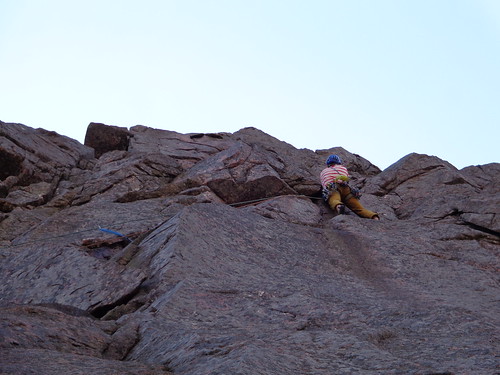
A little blue speck beneath The Pillar at Diabaig. I'd wanted to climb this route for years and had said that if I could do this, The Bug and The Needle this summer, anything else would be a bonus. Onsighting E3 and headpointing E5 and E7 feel like pretty big bonuses.

Post-Pillar pleasure

Steve in similar post-Pillar shock and awe

Steve on the first pitch of Foil on the Main Wall at Diabaig

Monday, 14 September 2009

Light and Dark

Liathach and Ben Eighe from Sgurr a' Mhuilin, Strathconnon
In the same way that Aristotle said that "one swallow does not a Spring make", I'm sure that one high pressure system does not an Indian Summer make. Indian or not, however, this weekend's weather was good enough for me to throw off the oppressive shackles of race training and to go climbing in the sunshine. Yippee. Little did I know it but I was in for two very contrasting days.

Saturday dawned sunny and still as Alex and I hit the road north to Gairloch in search of a day's sport climbing on shiny bolts. Our destination was Grass Crag - a short wall of perfect vertical gneiss, sporting routes from F5 to F7a in a beautiful, friendly spot. In total we ticked 11 routes, included a 6c onsight (my P.B.) and a 7a redpoint, laughed, drank beer and revelled in the jeopardy-free experience that bolted rock affords. By the end of the day were so tired we both fell off a 6a+ before retiring to the wonderful Bridge Cottage Cafe in Poolewe.


Alex ready for another route at Grass Crag


Climb responsibly: wear a helmet.


When I woke up on Sunday and peeked through the curtains it was obvious that a different kind of day was in store. Low cloud shrouded the hills of Strathspey and a fine drizzle fell, saturating everything. I'd agreed to join Kev Shields to act as moral support/belay bunny on his quest to headpoint his first E7. Kev's inspiring story of climbing with only one hand has been written about by many so I won't dwell on the story, but suffice it to say that having moved to Fort William in the summer and climbing his first E5 and E6 in consecutive weeks, his lifeime goal of E7 isn't far away. He'd hoped to get on Firestone at Hell's Lum, but the weather had other ideas, so instead we headed up to Creag Ghlas in Strathconnon fo a look at another of Julian Lines' psycho-slabs, The Unknown Soldier. Paul Diffly from Hotaches Productions was with us too, filming Kev for an upcoming DVD.

Kev working The Unknown Soldier

It turned out that a combination of friction-sapping sunshine, a two-hand specific move on the crux and the trifling matter of a potential groundfall from 15 metres eventually put paid to Kev's attempts and we all walked back to the car in one peice. But, for a short time it was evident that Kev was building up to the lead, entering the dark headspace that dangerous climbing demands, and each slip or mistake on the top-rope seemed to be magnified into the bone snapping reality that it could spell. In the end, Kev realised that now wasn't the time to push the boat out, and sensibly came down unscathed.

Contemplation

I've got very little experience of this type of climbing, but I've done enough to know the feeling of inevitability, both horrible and thrilling, that Kev was going through. As soon as you get on the route and start to make progress you suddenly feel like you've entered into a pact, and you know that at some point, no-matter how distant, you have to climb it. The fact that it's a pact with yourself doesn't seem to matter, in fact, it seems to make it even more unbreakable, and the Damoclean sword just hangs over you until you end it, one way or another....


Thursday, 10 September 2009

A Conservation Conversation

Is this Sifaka worth protecting?

A conversation I had yesterday got me thinking about the nature of my work. Someone told me they thought that capercaillie (very rare birds that I’m involved in trying to conserve) were a mixed blessing. It took me a while to work out what they meant. Surely, the presence of one of Britain’s rarest and most charismatic birds anywhere is a good thing. We should be protecting them, shouldn’t we? Like me, the people I was talking to are outdoorsy types – runners and climbers - but to them the presence of capercaillie means restricted access to land, paranoid land-owners and, potentially, millions of pounds thrown away just trying to save a bird. It got me thinking about motives, and ultimately, about my personal view of the importance of nature conservation, and it struck me how it’s really a very personal issue.

As a professional tree-hugger I try to question the work I’m involved in and the motives behind it. I’ve thought long and hard about the hows, whys and wherefores and am still unsure of lots of the answers. Here are a few thoughts to mull over:

Why should humans bother protecting other species or habitats at all?

To what extent should humans intervene with nature in order to bring about our own goals, and by what ‘right’ do we intervene?

Is it acceptable to protect a species or habitat at the cost of human development?

If one rare and protected species survives by eating another rare, protected species, what are you supposed to do?

Are some species more worthy of protection than others?

In trying to answer these seemingly basic questions you very rapidly go from biology and ecology to much bigger issues of morality and philosophy, and people from different cultural backgrounds or points of view will give wildly differing answers. So, how do we decide who’s right, and how do we decide how to go about saving this planet that we’re single-handedly ruining?

Stormy times ahead