Monday, 29 September 2008

As You Sow, So Shall You Reap

Climbing is GOOD for you

My recent wishes for a climbing partner have been granted. Chris took Friday off work and faced the long drive North to Forsinard, kicking off the exploration of Culfern Crag. Despite a pretty showery weekend, we made good use of the sunny periods between deluges and came away with 5 new(?) routes. It’s still unconfirmed that this is virgin territory, and I’m awaiting word from the powers-that-be, but regardless, we climbed everything on-sight with no prior knowledge of what loomed above, and we had a bloody great time.

The weekend began with Chris deftly repeating my highball problem The Merlin on a beautifully sunny Friday evening - good going after five and a half hours behind the wheel from Edinburgh, and a pleasant introduction to some of the quality to be had.

Chris making light work of The Merlin (E1 5c)

The Merlin again, this time I gurn my way up in the twilight

Saturday’s adventures started on a 10 metre slab at the south of the North Sector (as we were calling it), where I was able to link protection in breaks and cracks straight up the slab’s left side. From below I thought that it would be pretty trivial, but I was soon shown otherwise and was glad of the gear, as minimal as it was. It was pretty thin and bold stuff for it’s 10 metre length, and my shout of joy as I topped-out was as much from getting up it unscathed as it was from the prospect of it’s being a first ascent. Consultation with Chris after he seconded it mooted a grade of HVS 5a, and I’ve decided to call it Flow Country Scene, in honour of the distinct lack of climbing in this part of the world. On the right side of this slab, Chris then picked his way up Prickly Pear. This followed thin seams directly to the top with just enough gear to keep you happy, but not much more than that. We decided that Severe would be a fair grade for this little peach.

Me on tip-toeing up Flow Country Scene (HVS 5a)

Chris seconding Flow Country Scene in the sun


Chris on the F.A. of his Prickly Pear (Severe)


On my request, Chris got hold of a wire brush (thank you Edinburgh Sculpture School) and it turned out to be a saviour for cleaning routes. Nothing we climbed was utterly filthy (relative to, say, Back Bowden’s Dark Side, anything above 3 metres at Kyloe-In or everything in Somerset), and there are a fair few other lines that would be good if they weren’t a foot under lichen, but understandably, untouched slabby rock at sea-level isn’t always as clean as a whistle. Part of the fun of onsighting these routes was hanging on whilst uncovering hidden edges and cracks, and slowly changing a rock wall into a route.

Next up we headed to the steep Central Wall – the most extensive area of rock at Culfern, but also the least helpful. Where it looks protect-able it’s covered in ‘Gogarth Sea Grass’, and where it’s really clean it’s overhanging and appears totally gearless. One exception to this is at the right end of the wall, where the steepness is split by two vertical cracks leading into a small hanging corner, and because it’s still pretty steep it’s very clean. The prospect of good gear was enough to spur me into tying-in and having a look, and by golly gosh, I’m glad I did. After placing good wires at full stretch from a ledge at two metres I took an age to puzzle out the next moves. A boulder-problem crux was then followed by sustained, well protected, steep climbing on incredible jugs and flakes all the way to the top. As I sat at the top, pumped and grinning, huge skeins of migrating pink-footed geese flew overhead in their characteristic ‘V’ formations, honking encouragement to Chris on second. His gurn as he pulled over onto the final slab said it all.
A big stretch for the first gear
Steep'n'Juggy: Eka Be (E1 5c)

Neither of us could quite believe how good it had been. Despite it’s small stature (about 12 metres), it’s one of the most rewarding routes I’ve done; steep, pretty safe, a hard(ish) crux, pumpy, excellent rock (the kind of gneiss where flakes look like they’ve been glued on), but all mingled with the uncertainty of not knowing if it would continue. Awesome. Mind you, I would say that, it’s my route (I hope). It’s called Eka Be, which means ‘big yes’ in Malagasy (Madagascan), in honour of Jones. After all, it was her birthday. Grade-wise, we thought that E1 5c was fair, but if you were a lanky bastard the crux would be a bit easier. The setting sun brought the day to a close, and as we drove back to mine we were already excited about what tomorrow would bring.

Sunday dawned with the climber’s least favourite weather: sunshine and showers, and continued that way for much of its length. By midday we made it to the crag and Chris started us off with a route in the Southern Sector. Flakes up a slab led to an airy wee arête, which was sadly escapable, but if you stuck to it it was good fun. Chris dubbed it Turtle Head Ridge (VDiff), due to what he called “environmental factors”. I fear that the environment he referred to was in his underpants, and had nothing to do with exotic marine macro-fauna. Shame.


Chris showing his turtle head on Turtle Head Ridge (VDiff)

I then geared up beneath a very gritstone-esque blunt slabby arête, also in the Southern Sector: a very obvious feature to climb.

What line shall I climb? Hmmm.

After stepping on and clipping the first gear, a heavy shower passed over, so I down-climbed and untied and we legged-it to shelter. Twenty minutes later the sun was out once more, the rock was dry(ing) and I was back in the metaphorical saddle. Some lichen removal and a fair bit of faith in finding better holds above allowed me to gain the arête where it steepens and reach good holds and wires in a crack to its right. More scrubbing, some balancey rock-overs and a woop of delight saw me at the finishing jugs and setting up a belay, whereby another, heavier squall arrived, so we untied and high-tailed it to the car. A good while later it was dry enough for Chris to tie in for the second, which he sailed up despite the greasy conditions. Taking all into consideration (not much useful gear until a fair way above the crux) we gave it HVS 5a and I’m calling it Run For Cover. At this point, another shower soaked us again, so we gave up and ran away.
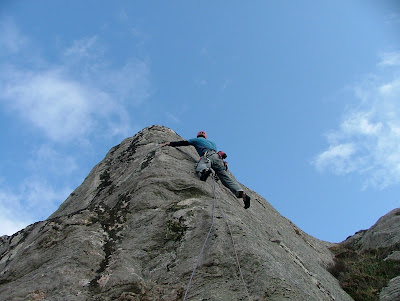
Me on the prominent 'gritty' arete of Run For Cover (HVS 5a)

And there you have it, including my previous offering of The Merlin, 6 new routes climbed at Culfern Crag, between VDiff and E1 (I’ve decided that E2 6a is a bit high for The Merlin and am settling on E1 5c). For those who are after an adventure, there are still a load more to do, from easy-looking lines that will require a bit of brushing, to clean, steep, bold routes that will require a cool head and steely fingers. Most routes will only be around 10 metres long, but will pack a fair punch. If anyone does come up here to climb new routes, make sure you do Eka Be too, it’s fooking excellent! Saying that, do all the routes we did, they all follow obvious lines or features, and the more mileage they get, the cleaner they’ll be.

In all honesty, it’s a mystery to me why this crag isn’t covered in Northern Highlands North when other minor (crap sounding) crags in the same vicinity are. Culfern is South and West facing so gets all the sun going, it’s obvious from the road, it’s beautifully situated, with views to the sea and across the Flow Country, the rock is, without exception, superb (not a single hold snapped on either of us) and it’s a friendly kind of place (no death landings or dank corners here). If climbers have been willing to develop the few good bits of rock on the North Coast within 20 miles of Culfern, why haven’t they been to Culfern?

However, knowing my luck with claiming new routes, the place was probably cleaned up years ago by ‘hard men with beards’. We’ll see.

Saturday, 20 September 2008

Farewell Jones, and other stories.

Well, it’s been a funny old week. I’ve been down in Stafford and Somerset, spending time at home and with Jones before shipping her off to the far side of the world. I tell thee, that were an emotional morning – she almost got a tear out of my stony heart. How dare she. She's spending a year in Madagascar working for Azafady, a charity based in Fort Dauphin in the South East of the island. They're involved with all sorts of community projects, rural development and the incredably biologically rich environment. Jones is chronicling her year in Madagascar at Eka Be, so tune in for regular postings from paradise (not that Fort William isn’t paradise, of course). I’ve added a link to the blog list on the right of this here page too.

So, before that fateful morning in Terminal 2 at Birmingham airport (the starting point for all international adventures, no doubt) when Jones disappeared into the departure lounge, we had been out and about on the rock. Following on from redpointing my first 7a in Cheddar last time I was home, I redpointed another on Sunday, this time in Somerset’s dingy, dark and dismal North Quarry. To the rational mind it’s a proper shit-hole, and not worth the effort of finding, especially with the hallowed walls of Cheddar, Brean and Uphill nearby, however the place has sentimental value for me.

North Quarry is a big hole in the side of Crook Peak, the extension of the Mendip Hills just above my parent’s cottage, the hill that I spent my entire childhood exploring, walking, running, cycling, shooting bunnies, drinking and bivi-ing on, and instilling a deep love for nature and the outdoors in me. In fact, North Quarry is where the idea of going rock-climbing came from in the first place. My good buddy Luke and I were scrambling about on the easy angled limestone one day when some ‘proper’ climbers turned up with ropes and all and started to crank up the steep and scary western walls. Inspired, we bought some kit, went to the indoor wall, learnt the ropes and before long were driving hither and thither across the Mendips in search of rock, grubby mits firmly clenched on Martin Crocker’s Avon and Cheddar guidebook. Happy days.

Crook Peak, my childhood playground (Photo: Jon Marshall)

Times Past: Me on a route on The Glacis, Fairy Cave Quarry, Summer 2006

Anyway, the bizarrely named Motorway Sheepdog is actually a pretty good route, despite it’s fairly grotty appearance. A lot of these Mendip limestone quarries are very slate-like, as the limestone sheers to leave smooth, slabby walls with nay gear and nay grips, all in the familiar rotting post-industrial waste land. It took me a few goes on the top-rope to suss out all the moves, but after a bit of foot-work here, some re-balancing there, some good old-fashioned faith in friction and the acceptance that sometimes it is just plain hard, I felt like a redpoint attempt was on the cards. Surprisingly I did it on the first go. Woop woop. Top-marks to Jones for the belay.

Setting off on Motorway Sheepdog (F7a), we only had a thin half rope so had to double up.
(Photo: Sarah Jones)

A very pleased me after the successful redpoint.
(Photo: Sarah Jones)

Next day we were in Staffordshire, so made a bee-line for the Roaches, where limestone crimps were exchanged for grit-stone slopers. It took a while to get used to, initially on Prow Cracks (Diff*), then the very good, if technically imbalanced, Jeffcoat’s Buttress (HS 4c, 4a***), and then the very, very good Safety Net (E1 5b***). As the drizzle started to appear we strolled along to the Hard Very Far Skyline and I tried in vain to get established on Wild Thing (E1 5c**), before giving up and running away.

Grit-stone detail: I think this is Chris belaying me on Nosepicker (E1 5a) at the Roaches in April 2007.
(Photo: Sarah Jones)

Jones safely packed up and shipped off, I made my way back to Somerset and have managed a bit of bolt-clipping at Cheddar with my good friend Johnsey, of Nova Scotian wedding fame. We did 7 routes between F5 and F6b (mainly F5, of course!) in two and a bit hours on Overshoot Wall, Arch Rock and Horseshoe Bend Buttress. Not bad mileage.

So, my week off is almost at an end and I’d better get packing. Next stop, Forsinard, the ends of the known world, and two more weeks of bog-trotting, sphagnum counting and plant measuring. Bring it on.

Sunday, 14 September 2008

Culfern Crag, Part 1


The North sector of Culfern Crag, Strath Halladale, Sutherland.
The only bit that I have touched (so far) is to the far left of this photo, and looks tiny from here.

Turns out, this is the place to come to find the beating heart of the Flow Country new-routing scene. Perhaps. So, this crag I mentioned:

Culfern gets a short paragraph in Northern Highlands North, basically acknowledging its presence and location (though it gets the latter slightly wrong), but there is no mention of specific routes. So, on a day off last weekend I went for a stroll with some shoes and a chalk-bag and ended up coming home with soar tips and pumped arms. What I had found was far better than the guidebook description. For a start, the rock is very good gneiss, although, unsurprisingly, it's pretty dirty in places. There are two main sectors, both of which are no more than 15 metres in height and vary from a couple of degrees overhanging to pleasantly slabby. Both look like they will provide some nice trad lines, although the highest and steepest sections look pretty gearless. There are also another few slabs and walls that will provide routes and good bouldering separate to the main crags.

On my three trips up there since last Sunday I’ve identified at least five obvious lines that will muster gear and look do-able by myself (i.e. maybe between Severe and E2), but there are lots more that look a fair bit harder/bolder/dirtier. Most of my attention has been spent on the bouldering at the south of the southern sector, and at the small steep wall at the north of the northern sector.

The northern-most wall of the north sector.
My line climbs the intermittent thin crack on the left.

This latter wall gently leans for a few metres then kicks back to plum vertical and varies between about 8 and10 metres in height. Two thin vertical cracks snake upwards at each end, and it was the left-most of these that I climbed on Thursday evening. To begin with I worked on bouldering up the start then jumping off, hoping to come back on another day with a belayer, since there would be good gear in the crack above. However, with the slim likelihood of a belay and a good grassy landing below, I decided that it would be OK to treat like a highball boulder problem, so came back a few days later with the pad and surprised myself by doing it on the first go. Turns out that it’s a perfect candidate for such treatment, and after a couple of very busy weeks at work, was just the tonic that I needed.

A video still (hence low quality) of me on The Merlin.
The top quarter is hidden behind the tree.

It’s hard to say whether it’s a route or a boulder problem (what’s the difference nowadays?), but it’s very much in the style of things like Pinup at Back Bowden; a stiff start followed by easier bold climbing at a height that you wouldn’t want to deck from.

Should it turn out to be a new route, I'm deciding to call it The Merlin, in honour of a surreal episode that occurred last week when a juvenile merlin (a small falcon, for those not of the ornithological bent) landed on my head. I was collecting vegetation structure data out on the bog, so was hunched over a wooden measuring pole, recording plant heights. Incidentally (thankfully) I was wearing a baseball cap. All of a sudden, I heard a whirring, and then felt a slight heaviness on my head. I automatically flinched and the heaviness ceased and the whirring got louder, before quickly receeding. I looked up, and rapidly heading off into the distance was a rather embarrassed merlin. I couldn’t quite believe it.

With a spot of luck, this won’t be the last route that I do there, but I suspect that it’s the only one that I’d be happy soloing, so it may be a while….

So, the full shebang:

The Merlin, E2 6a, 8m
Start beneath the left hand crack in the northern-most wall: a distinctive pink stripe rises from right to left. Use edges to reach holds in the rising pink stripe, then gain and follow the crack to the top. Protectable.

This video shows me on the route again, shortly after my (the?) F.A.

Thursday, 11 September 2008

Something New?

The briefest of missives, which I will endeavour to expand upon when time/speedy interweb sees fit to allow:

While to-ing and fro-ing up Strath Halladale (read Far, Far Away) in the name of work, my eye kept resting on a large chunk of rock that seemed to glow pink in the evening sun. Last weekend I took it upon myself to explore further, and couldn't believe my baby-blues when I stumbled upon treasure. I have found a crag. Now, the area guidebook, SMC's Northern Highlands North, mentions 'Culfern' as being a series of slabs and corners with next to no gear, and as such it's confined to top-roping, beginners and abseiling. Having given the place the once over it's clear that they havn't explored it properly, and I feel duty bound to let the reading public (all two of you) know the truth.

It's awesome. I won't go in to all the details, but suffice it to say that there are a good few trad lines and some good bouldering on sound, steep gneiss.

This evening, after a day of vegetation surveying, I soloed the probable first ascent of a cracking little line on the Norther-most crag. It's only about 8 metres, so it's in the micro-route/highball boulder area and takes the left hand thin crack in the gently leaning wall. It reminded me of those little routes you get on grit and in the County, with a hard start and then steady, heady climbing above, and would say it's around E2 6a/highball V3. I've got my eye on a few other lines too, but think gear and a belayer will be required. So, if any one out there wants to bag some first ascents get in touch. I am a long way North, but there is a train station next to my house (look up Forsinard).

I'll blog again soon with some pics of the crag and a video of the route (I was going to film the opening moves to get a video still to put on this, but it was so fun I ended up climbing it again).

Stoked...

Sunday, 31 August 2008

The End of the Road

A flat wilderness stretches away to the horizon, scoured and weather-worn. A handful of sorry looking trees hold out under the endless skies, and a cluster of squat buildings huddle around the tiny station house, blasted by the uninhibited wind. Besides the painfully slow rail journey to get here, there’s one tiny road in, one tiny road out, and even they lead from no-where, to no-where. Few come here, and at the ends of the earth, who can blame them.

Continuing with this narrative you’d be forgiven for expecting the entrance of tumble-weed, a cattle ranch, Stetsons and six-shooters, but this isn’t a vision of the American West in the mid-Nineteenth Century, it’s my home for the next month. The tiny hamlet of Forsinard, in the middle of the bogs and mires of Sutherland in the Northern Highlands, is at the centre of a huge RSPB reserve. The Flow Country, as it is appropriately known, is an extensive area of wetlands, lochans, streams, heaths and swamps that stretch for miles and miles, creating a unique patchwork of shifting, seeping, oozing plant-life.


My noble steed, with the flatlands of Forsinard beyond
I’m here to repeat a study that was carried out ten years ago, looking at the difference that a deer fence has made to the vegetation of part of the reserve. A patch of land was initially fenced off, ready for planting for forestry, but was bought by the RSPB before the arrival of any trees. The fence, however, remained for a further ten years, and the lack of attention by deer led to the vegetation growing taller, denser and ranker. Many of the bird species that rely on these extensive bog habitats (golden plover, dunlin, greenshank, hen harrier) prefer open vegetation for breeding and perusing for food in, so the fence came down. With no fence, the resident deer population can get in and graze and trample to their hearts content, getting the vegetation back to its original, open state. With the fence gone for almost ten years, I’m up here to compare the vegetation inside the old fence with vegetation outside the old fence. Interesting, non?

The only problems with my new home are that it’s about a million miles from anywhere, and that, for the most part; it’s as flat as a pancake. It is the Flow Country, so I guess it’s a good chance to perfect my bog-trotting in time for the OMM, but since deer stalking is one of the few sources of income up here, it’s not really advised to go ploughing through the mires willy-nilly. Harrumph. Maybe I’ll just have to run up and down the only road…..
__________________________


Prior to my buggering off up here I managed to keep up a spot of climbing. Jones and I climbed the uber-classic Agags Groove (VDiff****) on Rannoch Wall, Buachaille Etive Mor. It was my first route on this impressive bit of rock, and I’m keen to get back up there. When you look at it, you can’t help but wonder how routes of VDiff and Severe get up it.


Jones with a lot of air below, finishing Agags Groove

A few days later, Chris and I had a day’s tentative exploration in Perthshire. We started at Polney Crag, Dunkeld and climbed The End (VS 4c, 5a***), which was great, but after that seepage lead to me backing off Twilight (E1 5b**) only a few metres up, and made Beech Wall (HS 4c**) pretty hard because all the good holds were soaked. Despondant, we went for a look at Newtyle Quarry, to see what all the fuss was about. Naturally, everything there was wet and crozzly there, so we drove to Weem, to see what all that fuss was about. Again, we were rather disappointed to find a dank, dirty and dark crag in the woods, so when the rain arrived after a route apiece we weren’t bothered about heading back to Edinburgh.


C’est la vie.

Chris on pitch 1 of The End (VS 4c, 5a), the best route of a frustrating day.

Wednesday, 20 August 2008

Keeping Up Appearances

Jones on Pitch 1 of The Gutter, Polldubh

Back to holiday mode in the Fort. I’ve managed to wangle myself another short RSPB contract starting next week, so Jones and I are being lay-abouts in the Crucible in the interim.

I’ve been trying hard to get out and about on the rock, but it’s been proving tricky to juggle contracts ending, moving back to the Fort, the weather, the midge, and maximizing time with Jones before she ships off to Madagascar in a month, so it’s been a case of snatching opportunities as they’ve emerged. Even so, I’ve kept up some mileage.
I suffered from a spree of Munro bagging last week, after a run up Stob Ban in the Mamores Jones and I did the Ring of Steall a few days later. Five Munros in three days. Check it.

Then, on Wednesday I dabbled in an aspect of climbing that’s entirely new to me: head-pointing. Upper Scimitar Buttress in Glen Nevis is a steep 10m slab with an E6 6a, an E5 6a and an E4 6a, and not one of them musters a single runner. Sweet Little Mystery is the E4, taking a line on the left of the wall. Since it has no gear I thought that even if the climbing was OK it would be pretty committing, so some head-games would remain. A likely option for rehearsing the moves and seeing what happens.
Jones gives some scale to Upper Scimitar Buttress.
I climbed straight above Jones, to the left of the dirty streak in the middle of the slab.

With Jones swaddled in midge nets, Skin So Soft and Deet, I top-roped the line a few times, worked on some of the moves and cleaned some mossy holds (ecologist, moi?). After the initial surprise of finding the climbing do-able (maybe it’s not E4? Maybe I was on the wrong bit of rock?), I pulled the rope and waited for a lull in midge activity. Before long the midges settled down and I was faced with the mental struggle. Was I ready?

From what I’ve read about this kind of thing, and my own limited experience of working boulder problems and the odd sport route, the time when you eventually succeed on something you’ve worked on feels great, the mind clears and the climbing takes over – it was the same this time too. The difference was that the price of a mistake was a large amount of pain, so as I sat at the top and took it all in, the adrenaline started to course, my hands started to tremble and my grin began to widened. So, E4? Obviously, I have no idea what an E4 feels like. All I know is that it would have been a very scarey onsight solo, and wasn’t even sure if I would go for it after the first top-rope. All the moves were within my limit, but would have felt much harder and more precarious without prior knowledge. What ever it was, I’m chuffed.
Jones' view of me on the solo of Sweet Little Mystery


Last Thursday was another day in the Glen. Chris and Katy were up from the Burgh/London and we met them at The Alp. Jones lead the great Gutter (Diff***) on Pine Wall, and I climbed Tear (Hard Severe**) and SW2 (HVS 5b** or E1 5c if you ask me….) on SW Buttress. A rare low-midge blue sky day and a real pleasure.

The next time I put chalky fingertip to rock was on Sunday. Jones and I were down in Edinburgh to chill with city-folk, drink expensive beer and laugh at the Fringe, but Steev and I managed to escape the bustle and head to North Berwick Law for a brief session. I had hopes of red-pointing Fogtown (F7a**), which I had tried before. This time I made the tactical error of spending all my energy cleanly top-roping the route, and never got the strength back for the red-point attempts. Bummer. Steev got involved in a fair few routes, including onsighting Anarchic Law (F6a+/6b), top banana.
Steev sending Anarchic Law

Back up in the Fort, Jones and I got out yesterday (Monday) and climbed the Heatwave/Vampire combination (Hard Severe 4b,_, 4b, 4a**) on Cavalry Crack Buttress in the Glen. This climbs the first two pitches of Heatwave and the last two of Vampire, making a much more logical line than the two on their own. It was a really windy day, so when we broke through the arboreal verdance above pitch 1 the midges were blasted away and we were left to enjoy the great climbing and amazing rock on our own terms. At last, a route completed on Cavalry Crack Buttress! Afterwards we headed across to Road Buttress and, inspired by Gary Latter’s new Scottish Rock guidebook, I got on The Web (E2 5c**), only to be repelled by the crux a few metres from the top. Despite having a nest of gear, I just couldn’t make a huge span round a bulge and it was sickening to see my chalky prints just centimeters from a good hold when I abseiled down to get my gear. Some you win, some you lose, and some are just graded by lanky bastards.

Jones seconding pitch 2, linking Heatwave into Vampire


Maybe next time…….

Friday, 8 August 2008

Glory in Failure

If at first you don’t succeed, try, try and try again. Then, when all is about lost, get really drunk so that your hangover renders you incapacitated for any further attempts.

That just about sums up last weekend. On Saturday, Chris and I walked in to Coire an’t Schneachda twice, in vain attempts to climb The Magic Crack (HVS***). Both times it poured with rain just at the wrong moment, drenching any exposed millimeter of granite, and turning any climbing into a misery: queue abseil retreat from pitch 1. Sandwiched between these two attempts we went to Huntley’s Cave and climbed two routes, the first (Jam Crack, HS) in very gentle drizzle, the second (Double Overhang, HVS 5a***) in a deluge. Fortunately, the latter route was steep enough to remain dry, even in the biblical flooding that we experienced, and I’m glad I stuck with it.

Double Overhang (HVS 5a***) at Huntley's Cave. It's awesome.

On Sunday I worked at the RSPB Abernethy fun day, and proceeded to drink myself silly that night, so bank holiday Monday didn’t turn into the gnarly day of cranking that it might have done. With a forecast pointing west, Chris and I headed to Glen Nevis and climbed the Glen’s longest route, Autobahnausfahrt (VS**), thinking that something easy and long is just as respectable as something hard and short. Anyway, my 4b pitch was about as hard as my fragile state could manage.

The obvious moral message: climbing is daft, I’m off to get liquored.

In other news: my contract at Abernethy Forest is up, so once again I'll be a member of the great unwashed in Fort William. However, fingers crossed, there's something in the pipeline.

Pics to follow when I get a chance.